
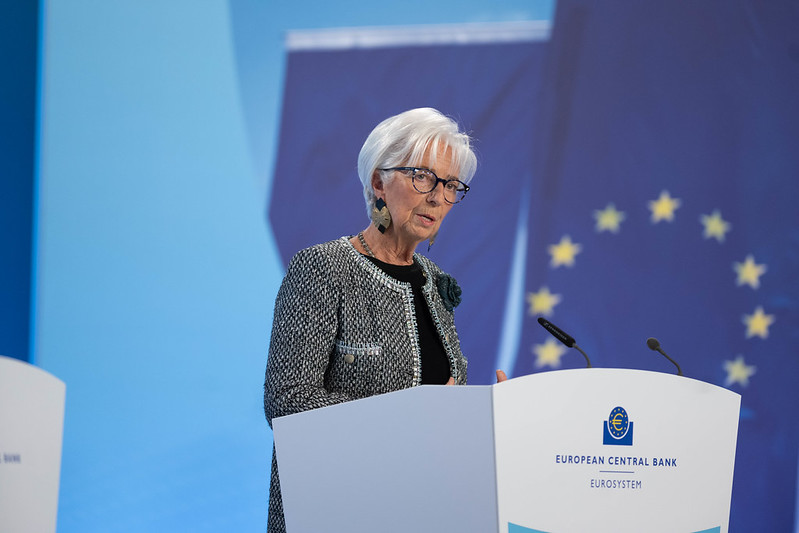
By David Barwick – FRANKFURT (Econostream) – European Central Bank President Christine Lagarde on Friday reaffirmed that the ECB would decide its monetary policy stance on a meeting-by-meeting basis, guided by data and without pre-commitment to any rate path.
Addressing the International Monetary and Financial Committee at the IMF Annual Meetings, Lagarde said that ECB policy decisions would hinge on the inflation outlook, underlying price pressures and the strength of monetary transmission.
She noted that the Governing Council’s goal remains to ensure inflation stabilizes at 2% over the medium term and said the ECB would continue to assess risks in both directions as the global environment evolves.
Turning to the economy, Lagarde said that tariffs, a stronger euro and global competition are weighing on near-term growth but that these effects should fade next year. Services activity remained solid and the labor market resilient, she said, supporting consumer spending as financing conditions improve.
“Risks to growth have become more balanced as the likelihood of major tariff-related downside risks materializing has fallen, owing to the new trade deal,” she said. “At the same time, the risk remains that renewed trade tensions could further dampen exports, investment and consumption.”
Uncertainty stemmed in particular from geopolitics, while higher-than-expected spending on defense and infrastructure would entail additional growth, she said.
“By fostering innovation, diversification and resilience, such ambitious reforms would also mitigate the economic tail risks arising from geopolitical tensions,” she said.
Lagarde said the euro area banking system remained strong, with high capital levels and diversified income sources. “While simplification and minimizing undue burdens are welcome, they should not mean deregulation: well-capitalized banks are necessary to support the real economy, particularly during economic downturns,” she said.
Work on a digital euro continues, she added. “A digital euro would complement cash and ensure that central bank money remains an option for everyday retail payments in the euro area,” she said. The project would safeguard monetary sovereignty while encouraging European innovation in payments.
Lagarde welcomed the EU’s adoption of the Markets in Crypto-Assets Regulation as a key step toward consistent oversight of stablecoins and urged further international coordination to prevent regulatory gaps.
She also voiced support for a strong, well-resourced IMF and warned that global fragmentation “into regional blocs will be detrimental to the world economy.”