
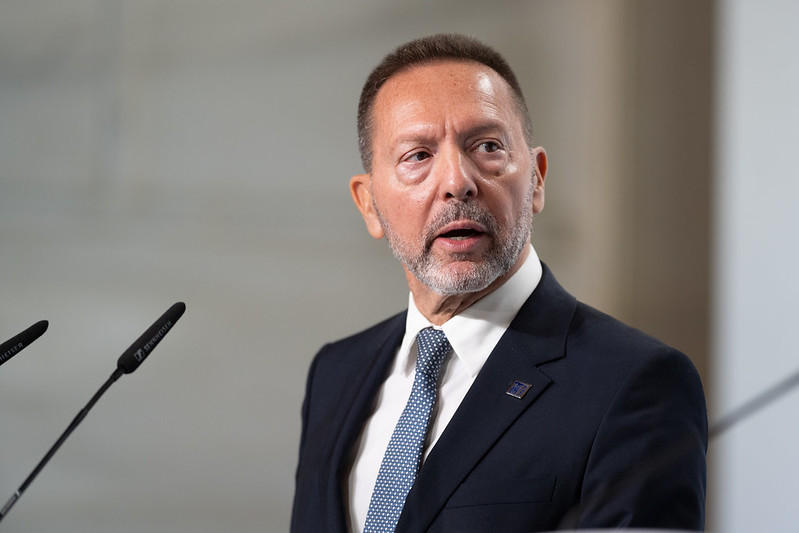
By David Barwick – FRANKFURT (Econostream) – European Central Bank Governing Council member Yannis Stournaras on Tuesday said the ECB had succeeded in engineering a soft landing, bringing inflation back to target without damaging growth, and that the institution’s independence and credibility were central to that outcome.
In a speech at a ceremony honoring him, the Greek central bank chief told an audience at the National and Kapodistrian University of Athens that the ECB’s gradual, meeting-by-meeting approach had allowed inflation to return to 2% in recent months from the double-digit levels of 2022, while the euro area economy remained resilient.
Favorable financing conditions, together with rising real incomes and expected increases in public investment, would support a medium-term recovery, he said.
Stournaras said the ECB’s ability to achieve this result was “inextricably linked to building the ECB’s credibility – a valuable asset – thanks to which, even during the recent sharp rise in inflation, long-term inflation expectations have remained very close to 2%.” Independence, transparency and communication had strengthened confidence in the ECB’s policy, he said.
Turning to Europe’s broader outlook, Stournaras said the continent faced a “quadruple challenge”: strengthening its productive base and defense capacity, shaping a more balanced model of globalization and reinforcing the international role of the euro.
Completing the banking and capital markets unions, removing remaining trade barriers within the EU and increasing and partly joint financing of defence were all critical to meeting these challenges, he said.
He said Europe’s current account surplus showed that it saved about 2.5% of GDP more than it invested, and that these resources should be used to strengthen domestic investment in high–value-added sectors.
Additional investment of around €800 billion, or 5% of GDP, was needed to close the gap with the United States and boost productivity, he said, citing the Draghi report.
He also called the July 2025 US-EU trade agreement capping tariffs on EU exports at 15% “a difficult but necessary compromise” that reduced uncertainty and preserved transatlantic cooperation despite its costs for European competitiveness.