
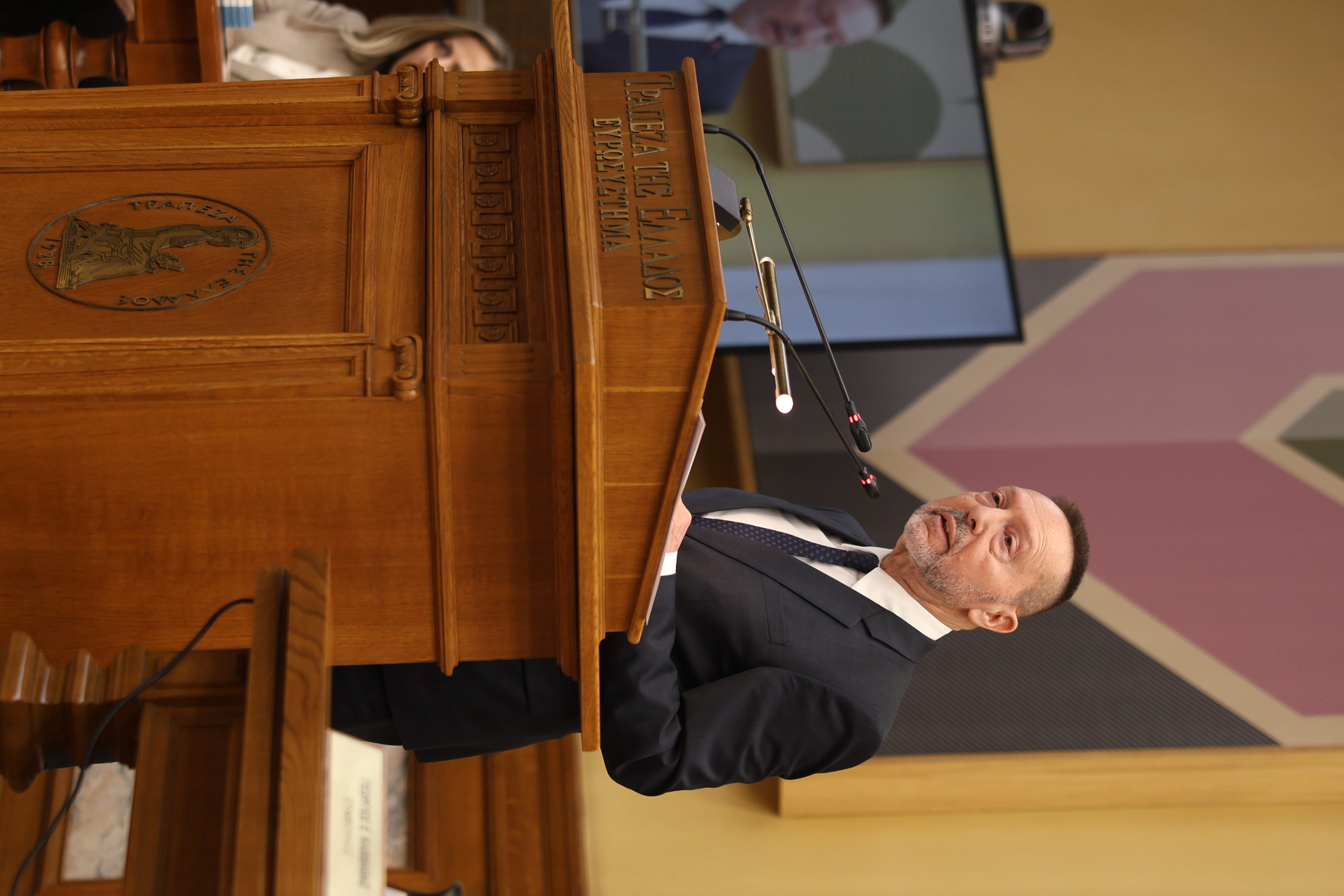
By David Barwick – FRANKFURT (Econostream) – European Central Bank Governing Council member Yannis Stournaras said on Monday that the ECB would have to consider a tighter monetary policy stance if Middle East-related energy shocks proved persistent enough to affect medium-term inflation expectations and wages.
Stournaras, who heads the Bank of Greece, said in a speech to the central bank’s annual general meeting of shareholders that the outlook for ECB monetary policy in 2026 was marked by greater uncertainty and a need for agility.
“In such an environment, the ECB Governing Council will assess whether higher energy prices risk spilling over into broad-based and persistent inflation, through expectations, wage developments and the price-setting mechanism,” he said.
“If energy cost pressures prove short-lived, the shock can be looked through,” he said. “But if they turn out to be stronger and more persistent, affecting medium-term inflation expectations and wage developments, a tighter monetary policy stance is to be expected.”
He also said the ECB was expected to maintain its data-dependent, meeting-by-meeting approach while standing ready, if appropriate, to adjust its stance.
More broadly, Stournaras said the recent military escalation in the Middle East was causing “serious disruptions to energy markets and global supply chains, with adverse effects on both growth and inflation.”
“These are likely to worsen if the crisis is prolonged or spreads across the region,” he continued. “Against this background, the balance of risks to the global and euro area economies has deteriorated significantly.”
For the euro area, Stournaras said growth was projected to slow to 0.9% in 2026 from 1.4% in 2025 because of the war in the Middle East, heightened uncertainty, and energy-market disruptions, which he said were increasing the risk of stagflation.
The disinflation process in Greece was expected to be halted in 2026 by renewed exogenous cost pressures from international energy markets, he said, with headline inflation seen rising to 3.1%, even as core inflation eased to 3.0%.
Stournaras also said fiscal policy would matter for the ECB’s response. Targeted and temporary measures could cushion the effects of the shock, he said, but broad-based and permanent measures could add to demand and complicate monetary policy.
Reviewing 2025, Stournaras said euro area inflation had declined to levels consistent with the ECB’s medium-term target. “Against this background, the Eurosystem’s monetary policy in 2025 gradually became less restrictive,” he said.
He said the rate cuts that began in June 2024 continued into the first half of 2025, bringing the cumulative reduction to 200 basis points by June, while since July 2025 the Governing Council had kept its key policy rate unchanged at 2%.
Much of the speech focused on Greece, where Stournaras said the economy had become more resilient and was expected to grow by 1.9% in 2026, outpacing the euro area despite a weaker external environment.