
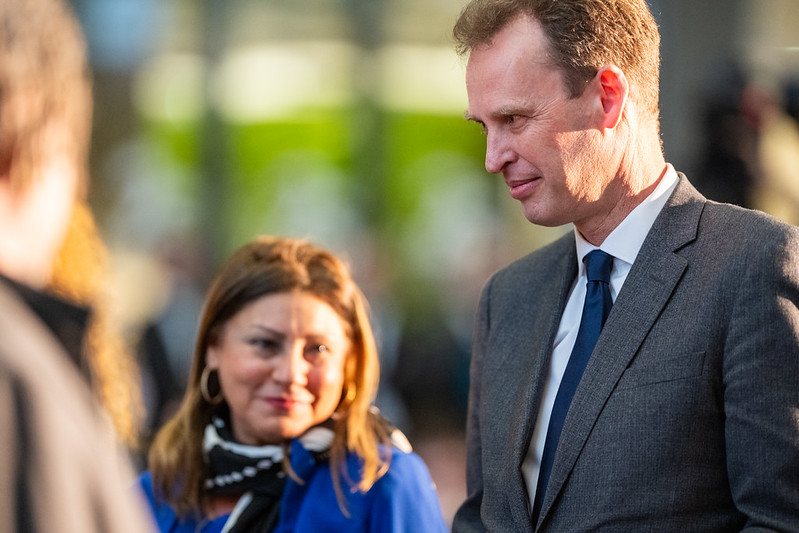
By David Barwick – FRANKFURT (Econostream) – European Central Bank Executive Board member Frank Elderson said on Tuesday that Europe’s dependence on imported fossil fuels was making it harder for the ECB to maintain price stability and argued that meeting the continent’s clean-energy targets would reduce the link between volatile global markets and domestic prices.
Elderson wrote in an ECB blog post that repeated energy shocks had become a macroeconomic vulnerability for Europe and a monetary policy problem for the central bank.
“Europe’s fossil fuel dependence poses risks to price stability,” Elderson said. He argued that Europe’s energy dependence “increasingly complicates the task of maintaining price stability.”
According to Elderson, Europe remains among the advanced economies most reliant on imported fossil fuels, a vulnerability exposed by the jump in energy prices after Russia’s invasion of Ukraine and again by the recent Middle East conflict.
He said this created a difficult setting for central banks because tightening policy to contain inflation could deepen a slowdown, while loosening to support growth could entrench inflation. Although central banks can in principle look through temporary supply shocks, he said repeated and persistent energy shocks tested the conditions under which that was possible.
Elderson argued that Europe could not eliminate geopolitical risk, but could reduce its exposure to it by cutting reliance on imported fossil fuels and accelerating the shift to domestically produced clean energy. If Europe met its sustainable-energy targets, he said, the connection between domestic energy prices and volatile global energy markets would weaken substantially.
As an example, he cited Banco de España estimates showing that wholesale electricity prices in early 2024 were about 40% lower than they would have been if wind and solar generation had remained at 2019 levels. Broader implementation of similar strategies, he said, would mean fewer shocks to households, firms, public finances and financial markets.
Elderson rejected the argument that the transition was prohibitively expensive. European Commission figures implied investment of around €660 billion per year between 2026 and 2030, he said, but Europe currently spent nearly €400 billion a year on fossil fuel imports and the marginal cost of domestically produced renewable energy was structurally lower once the infrastructure was in place.
He also said progress on the savings and investments union would be essential to mobilize capital at the necessary scale and called for policy certainty, appropriate incentives, delivery on existing decarbonization targets and preservation of the Emissions Trading System as a credible market-based carbon-pricing instrument.
“From a central banking perspective, the answer is clear,” Elderson wrote, arguing that the real question was no longer whether Europe could afford to make the energy transition, but whether it could afford not to.