
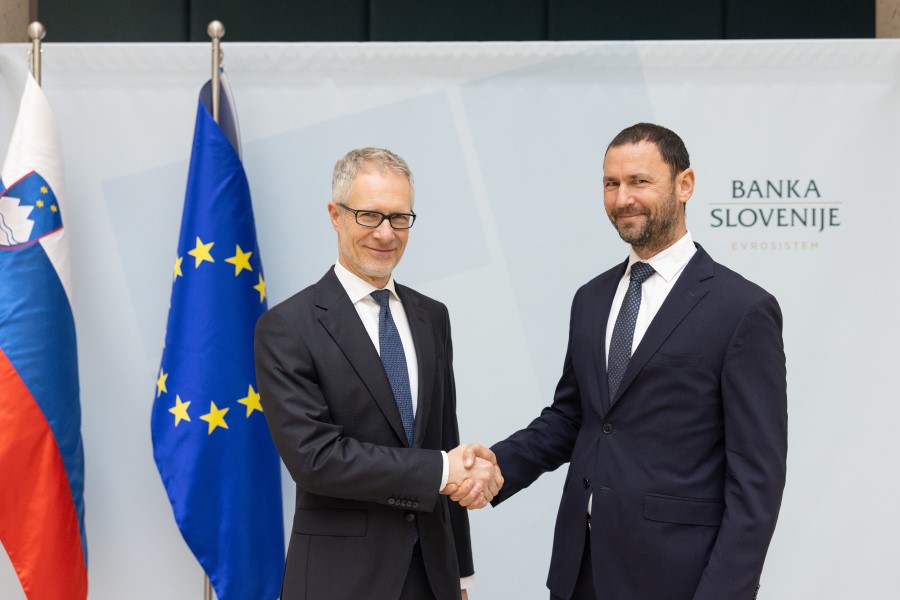
By Marta Vilar and David Barwick – FRANKFURT (Econostream) – European Central Bank Governing Council member Primož Dolenc said on Wednesday that the war in Iran would negatively impact both inflation and growth, while cautioning more broadly that the conflict would have repercussions for Slovenia, Europe, and the global economy.
Dolenc, who heads the Banka Slovenije and was speaking in a Banka Slovenije podcast, said the new flashpoint would “undoubtedly have an impact” but that what the actual impact would be “is not yet entirely clear.”
He suggested that the longer the conflict lasted, the more severe its impact would be on both the inflation outlook and economic activity.
“In reality, we are moving from bad to very bad, or the worst possible outcomes in both inflation and economic growth,” he said. “We can undoubtedly expect higher inflation and slightly lower economic growth.”
“We will see what the concrete impact will be in the coming weeks and months, as we obtain ever-newer data that will provide us with more and more information about how the conflict is developing and what the consequences are,” he added.
Looking back at the previous major geopolitical inflation shock, he said the ECB had succeeded in bringing the period of high inflation linked to Russia’s war against Ukraine and other factors back to target “without major negative consequences for the economy.”
“Today we are actually in a position where inflation is close to our 2%. Inflation expectations are also within this framework. The economic picture, that is the real economy, is better, more resilient. There is some positive economic growth. Another important fact is that fiscal policy today is less expansionary than it was in the post-pandemic period. And monetary policy is also different. Today we are kind of at a neutral 2% interest rate, in a neutral position, as far as monetary policy is concerned,” he said.
He added that all this suggested “there was no rush to take action and we could wait for our future meetings,” when the ECB would “have significantly more information about how things will unfold and what the consequences will be.”
“No one said our job was easy,” Dolenc said, referring to making decisions on monetary policy in times of uncertainty.
On banking services, Dolenc took aim at what he described as excessive cuts to physical access.
“Personally, and also as governor, I view the disproportionate, excessive closure of bank branches with discomfort and disapproval,” he said.
While banks had reason to adapt to customers’ growing use of digital services, certain groups of clients simply could not bank digitally and should still be able to access banking services, he said.
Related articles: