
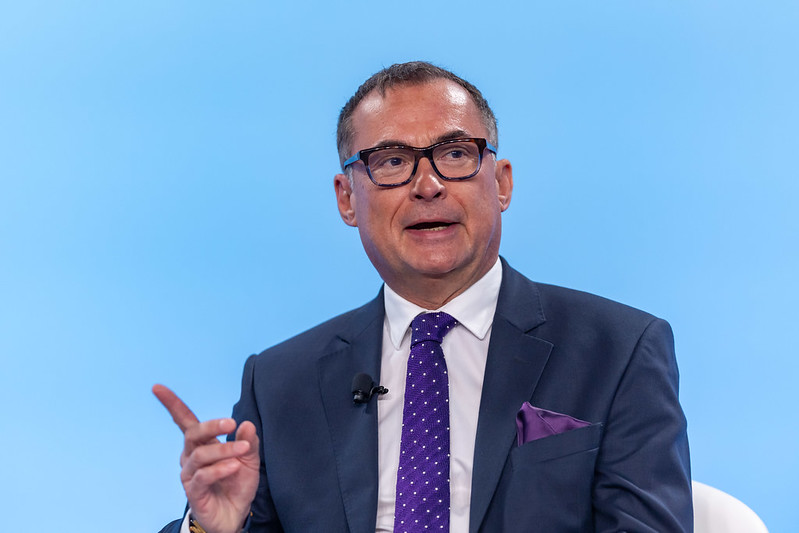
By David Barwick – FRANKFURT (Econostream) – European Central Bank Governing Council member Joachim Nagel on Wednesday argued that the digital euro had become a political project aimed at strengthening Europe’s sovereignty in payments, saying the bloc could no longer afford heavy reliance on non-European providers in such a critical area.
Nagel, who heads the Deutsche Bundesbank, said in a speech in Brussels that the digital euro would complement cash, help overcome fragmentation in the Eurozone payments market and reduce dependence on foreign infrastructure.
“Recent geopolitical developments have made one thing abundantly clear: it’s not wise to outsource our sovereignty,” he said. “Therefore, in my opinion, one of the key arguments for the digital euro’s introduction is strengthening Europe’s strategic autonomy.”
He said digital payments were now essential to daily life and described payment systems as critical infrastructure. Around two thirds of all card payments in Europe are now processed by major US providers, he said, calling that a very high level of dependency in a systemically important area.
“As a purely European digital payment alternative, the digital euro would reduce dependencies and strengthen Europe’s capacity to act,” he said.
Nagel also said the digital euro would help preserve the role of central bank money as payment habits become increasingly digital. Cash accounted for only 24% of the total value of day-to-day payments in the Eurozone in 2024, he said, while the value of e-commerce purchases doubled between 2019 and 2024.
He stressed that the project was “not about abolishing cash, but about complementing it.” The digital euro, he said, would provide “an additional form of central bank money for the general public.”
Beyond sovereignty, Nagel said the digital euro would support resilience and privacy. Thanks to offline functionality, payments would be possible even without electricity or internet access, while the Eurosystem would be unable to directly identify individual users, he said.
The Bundesbank chief also urged lawmakers to move quickly, saying the digital euro could become reality only if a firm legal framework was put in place. “I strongly believe that the legislative process can be concluded by the end of the year,” he said.
Nagel said the digital euro would leave room for private-sector innovation while giving Europe a secure and universally accepted payment option under European governance. “The digital euro is a concrete, practical step” toward strengthening sovereignty, he said.