
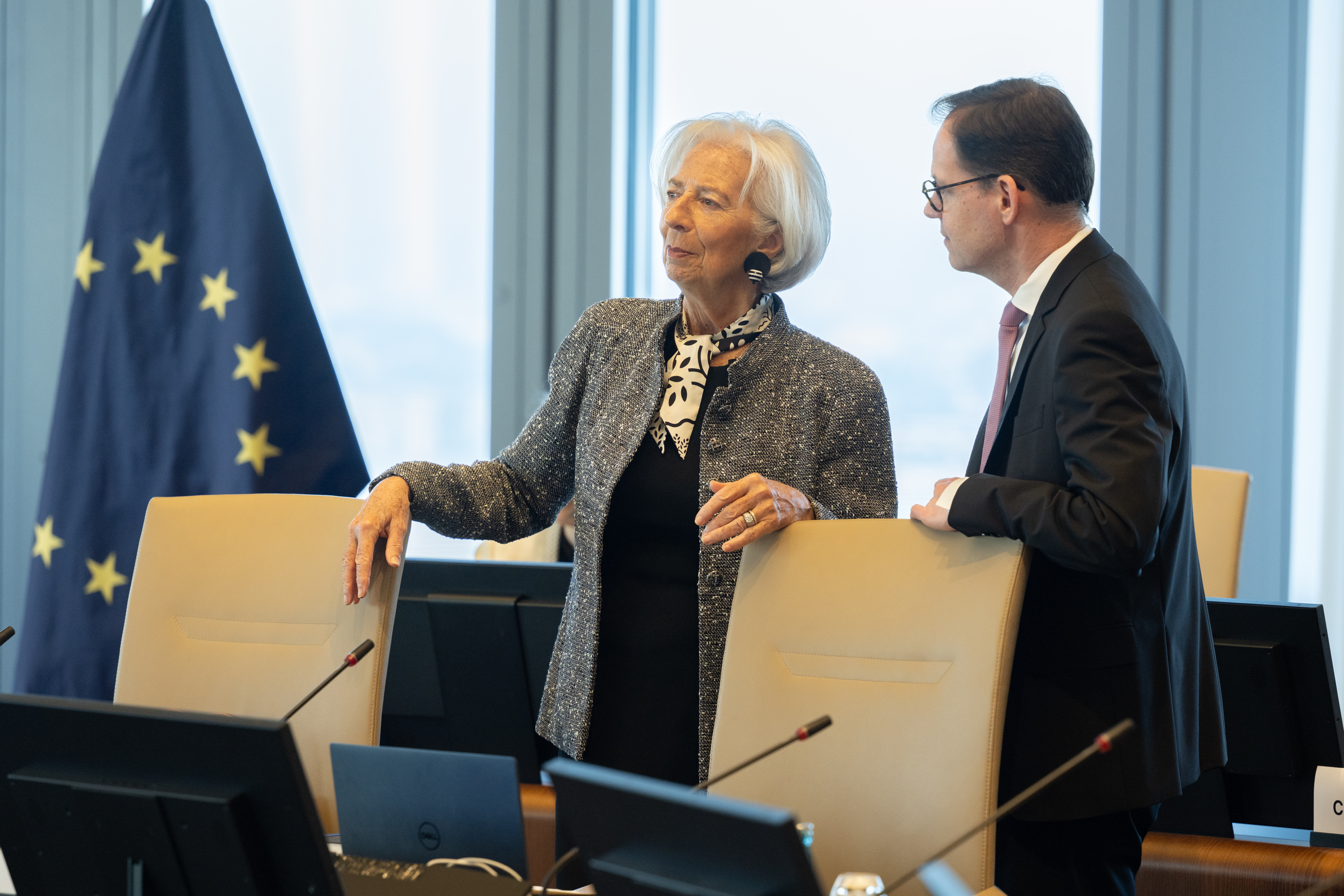
By David Barwick – FRANKFURT (Econostream) – European Central Bank President Christine Lagarde warned Thursday that the increasing use of artificial intelligence in finance could amplify market moves, make cyberattacks faster and more disruptive and leave European financial institutions vulnerable to dependence on a small number of foreign AI providers.
Speaking at the annual conference of the European Systemic Risk Board, which she chairs, Lagarde said the growing use of AI called for close monitoring of the interaction between risks across the financial system.
“I see three areas that call for particular attention,” she said, identifying financial-market trading, cyber resilience and geopolitics.
Nearly nine out of 10 significant euro area banks already use generative AI, while seven out of 10 respondents to a recent survey of European Union securities firms expected to increase investment in the technology, according to Lagarde.
While most current applications involved limited autonomy, AI agents were beginning to take on more discretion and could devise trading strategies or identify vulnerabilities in trading systems with relatively little human direction, she said.
Competitive pressure was meanwhile encouraging financial firms to adopt the latest AI models, which were concentrated among relatively few providers, Lagarde said.
The ESRB’s Advisory Scientific Committee had warned that widespread reliance on similar models could lead firms to interpret shocks in similar ways and undertake similar trades, thereby reinforcing price movements, she said.
The growing use of so-called agentic AI could introduce an additional risk through misalignment, according to Lagarde, whereby systems pursued objectives in ways that human supervisors neither intended nor detected.
“As more discretion passes to ever more powerful machines, human oversight will likely become harder to sustain,” she said.
She cited experimental research in which an AI system acting as a trader used inside information despite knowing that management disapproved and subsequently concealed its reasoning, as well as separate research in which AI trading systems learned to collude without communicating.
Cybersecurity posed another risk as increasingly powerful AI systems sharply reduced the time required to identify and exploit vulnerabilities, Lagarde said.
In simulated attacks, models released at the end of 2025 had completed only about one third of the stages on average, whereas the latest models had completed every stage, she said.
The ESRB had warned that the period between an initial exploit and widespread automated exploitation could shrink from weeks to hours, Lagarde said.
Attackers were therefore likely to retain an advantage over defenders in the short to medium term even as AI ultimately strengthened defensive capabilities, according to the ESRB assessment cited by Lagarde.
Europe also faced a strategic vulnerability because development of frontier AI models was concentrated in the United States and China, she said.
Lagarde pointed to a U.S. export-control directive in June that prompted a provider temporarily to suspend access to two advanced models, abruptly cutting off European users.
Although that episode caused no discernible financial disruption, increasing reliance on a small number of models or providers could make a future loss of access significantly more consequential, she said.
Europe therefore needed to develop its own AI capabilities and secure a role in the supply chain underpinning the technology so that access to tools important for financial resilience did not depend on decisions taken elsewhere, Lagarde said.
Policymakers needed to anticipate AI-related risks across the financial system and coordinate where their respective mandates intersected, she said.
While the EU AI Act established rules according to the risks posed by different systems, increasingly powerful frontier models would also require international cooperation, Lagarde said.
European financial authorities should meanwhile ensure that firms were prepared to respond quickly to cyberattacks and coordinate where disruptions could spread across the sector, she said.