
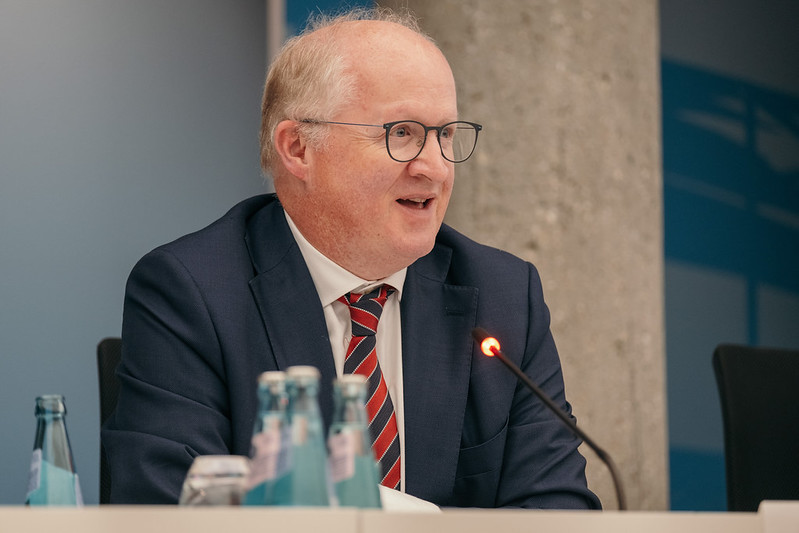
By Marta Vilar – MADRID (Econostream) - European Central Bank Chief Economist Philip Lane said on Monday that the ECB remains on a “middle path” in which a measured monetary policy response is appropriate, stressing that policymakers are not committed to a predetermined rate path.
“Taken together, this means that we remain in the ‘middle path’ for monetary policy, in which a measured response is appropriate to keep inflation in check,” Lane said in a speech at the ECB’s 2026 Monetary Policy Conference in Frankfurt.
Lane said it had been “prudent” to increase the deposit rate from 2.00% to 2.50% across the June and September projection rounds given the energy supply shock and other developments.
“However, we are not on a pre-committed rate path,” he said, adding that future decisions would be taken meeting by meeting and depend on incoming data.
Lane said the assessment of the energy shock needs to account for “demand destruction” channels that, all else equal, could limit the required adjustment in the monetary stance.
Higher energy prices reduce real household incomes and company profits, while geopolitical uncertainty could encourage precautionary saving and delay investment, according to Lane, who said that tighter financial conditions associated with the shock could further weigh on demand.
“All else being equal, these ‘demand destruction’ channels can limit the required adjustment in the monetary stance to ensure the timely return of inflation to the target,” Lane said.
Lane said the latest data showed that the energy shock remained the main driver of this year’s rise in inflation, with non-energy inflation contained so far.
“Underlying inflation indicators indicate that an upward shift in medium-term inflation has not taken hold,” he said, adding that the rapid price-adjustment mechanisms seen during the 2022 inflation shock had not been activated so far.
However, Lane characterized the renewed rise in energy prices since July as a “second wave” of the shock, posing direct upside risks to inflation as well as downside risks to growth.
Lane also pointed to forces that could increasingly weigh on activity and inflation. While fiscal policy is providing substantial stimulus this year, the ECB expects the fiscal stance to tighten in 2027 and 2028.
Recent increases in long-term interest rates will also “slow growth and reduce pass-through by more than projected” in the ECB’s September exercise, Lane said.
The ECB will therefore assess whether relative price shocks are transforming into broader inflation dynamics and the extent to which demand destruction is operating when setting future interest rates, Lane said.
- The author of this story can be contacted at marta.vilar@econostream-media.com