
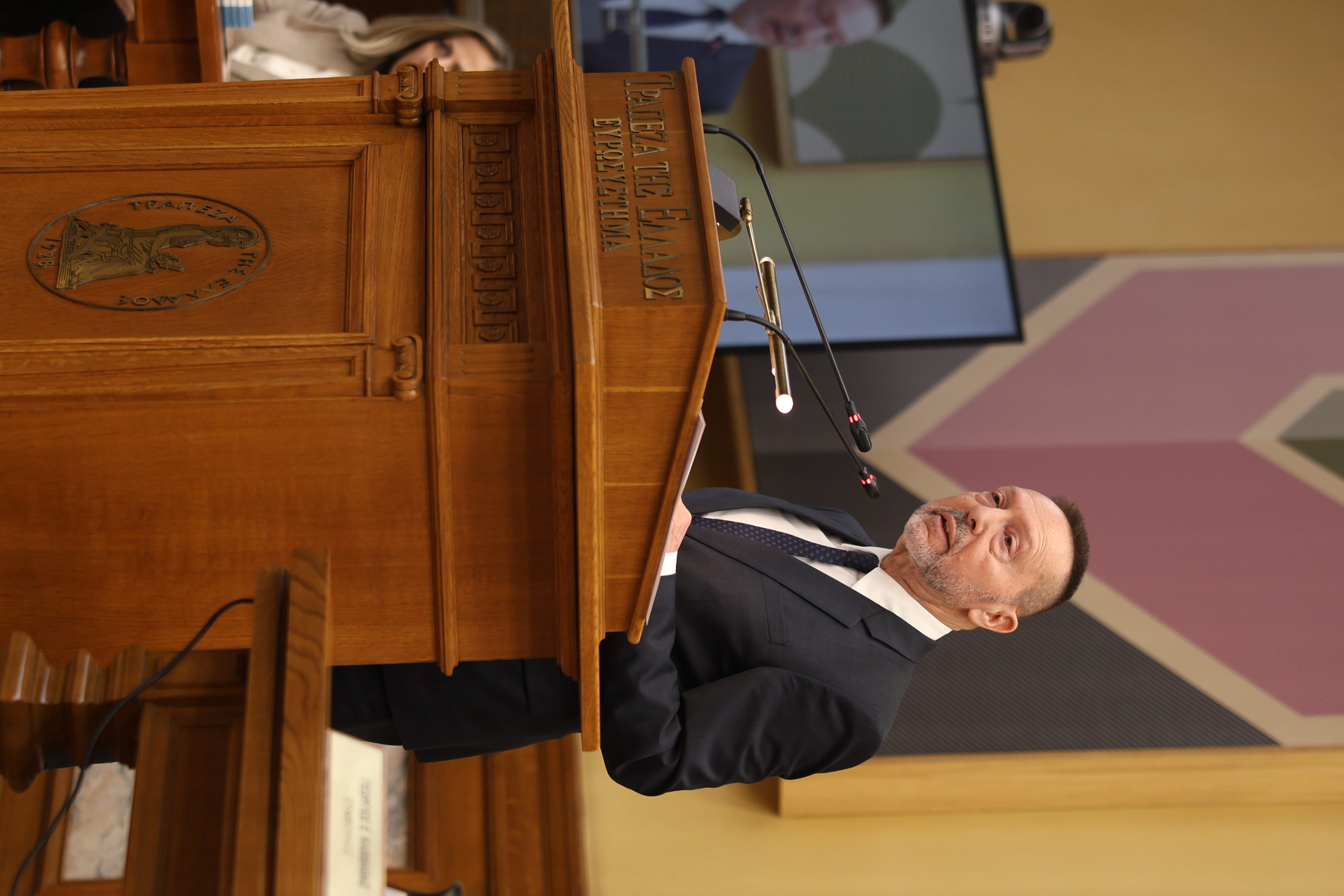
By David Barwick – FRANKFURT (Econostream) – European Central Bank Governing Council member Yannis Stournaras said Thursday that the absence of significant second-round inflation effects argued for moderation in further monetary policy tightening, even though repeated supply shocks and additional demand pressures meant the ECB could not remain inactive.
Speaking at the Istanbul Economic Forum, the Bank of Greece governor said the key questions were whether the current energy shock would prove persistent and how far it would spread through the wider economy.
“So, monetary policy cannot stay idle, okay? If it was only one [supply-side shock], we can overlook it. But now, it’s a series of supply-side shocks,” Stournaras said.
“Our main question is, do we have second-round effects? We don’t have second-round effects, or at least important second-round effects in Europe,” he said.
Inflation expectations remained well anchored around 2%, particularly at longer horizons, while survey measures showed the same pattern, Stournaras said.
Indirect effects from higher energy costs were nevertheless already visible because they were raising the prices of plastics, fertilizers and other goods, he said.
“So, what matters here? First of all, it’s do we have second-round effects? Not seriously. This is good. So, we should take this into account and be moderate in our monetary policy tightening,” Stournaras said.
He said policymakers also needed to assess how persistent the supply shock would be, whether it would spread beyond the sectors initially affected and how long it would last.
The current environment involved unusually high uncertainty, Stournaras said, making scenario analysis particularly important.
“I don’t think it makes sense now to say whether we are in the baseline or in the adverse or… It is in-between actually in Europe now, between the baseline scenario and the adverse scenario,” he said.
Stournaras rejected committing in advance to a particular interest rate trajectory, saying the conditions that had justified conventional forward guidance in the past no longer applied.
“Forward guidance was useful when inflation was very low and we were at the effective lower bound,” he said.
“Now, these conditions are not present. Inflation is above the target, interest rates are not close to the effective lower bound, and also, we have huge uncertainty …. We don’t have any visibility on the resolution of this uncertainty. So, it doesn’t make any sense to pre-commit to a specific interest rate path.”
Stournaras said the euro area economy was showing “some resilience,” with growth perhaps slightly stronger than previously expected even as inflation had risen.
“So, overall, growth has not been affected by the events I have described,” he said.
He said Greece was expected to continue growing at around 2%, helped by tourism and shipping, while the country’s positive output gap contrasted with a still-negative output gap in the rest of the euro area.
That divergence explained much of the difference between Greek and euro area inflation, he said.
Greek inflation was being driven partly by excess demand stemming from the strength of tourism and shipping, Stournaras said, while cautioning that their continued performance depended on how long the current crisis lasted.
“And I hope they will continue [to perform well], because it depends on how long this crisis will last. … [T]his is for the moment, we don’t know if it continues,” he said.
For the euro area more broadly, Stournaras described the current environment as primarily a supply-side shock transmitted through energy prices, but said demand-side forces were also at work.
He cited large investments in artificial intelligence and fiscal expansion in a number of countries, noting that several European countries had exceeded the 3%-of-GDP deficit limit, while the United States and Japan were also pursuing expansionary policies.
“So, it is not only a supply-side shock. In theory … if it’s one supply-side shock, we can overlook it, and monetary policy can’t do anything,” Stournaras said.
“But in our case, we have a series of supply-side shocks – it’s not only one – and also on top of this, we have also demand shocks.”