
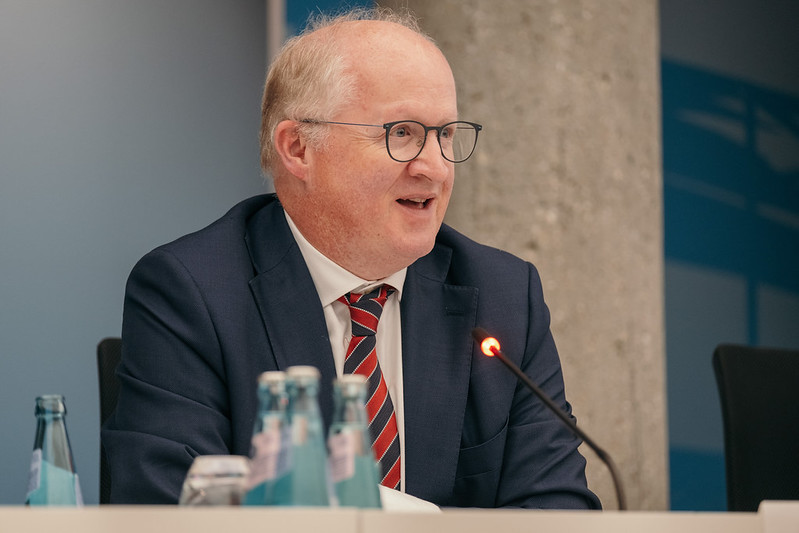
By David Barwick – FRANKFURT (Econostream) – European Central Bank Executive Board member Philip Lane on Tuesday said the ECB’s June rate increase was appropriate and robust, citing the energy shock’s pass-through to broader inflation and persistent upside risks.
In introductory remarks for an exchange of views at the European Parliament’s Committee on Economic and Monetary Affairs, Lane said incoming information about the intensity and duration of the energy shock, and the likely persistence of its inflation impact, had suggested that a 25bp rate increase in June was appropriate.
“This rate hike was a robust decision,” he said.
Lane said the ECB already saw “first signs that the energy price shock is feeding through to broader inflation,” and that even in a milder scenario prepared by Eurosystem staff, inflation would stay above target long enough to warrant a measured response.
Recent progress toward a resolution of the Middle East conflict was welcome, but uncertainty remained elevated and risks persisted that inflation would stay above the ECB’s 2% medium-term target for quite some time, he said.
“The Governing Council is not pre-committing to a particular rate path,” Lane said.
Interest rate decisions would be based on the inflation outlook, risks around it, incoming data, underlying inflation and the strength of monetary policy transmission, he said.
Lane said the Middle East peace agreement was welcome, but the situation remained fragile, with risks of setbacks or re-escalation.
The full implications for medium-term inflation and growth would depend on the intensity and duration of the energy price shock and the scale of indirect and second-round effects, he said.
The risks to growth were tilted to the downside and those to inflation to the upside, Lane said. Under adverse and severe scenarios, inflation would remain above target over the entire forecast horizon, while growth would be below baseline in the near term.
Under a milder scenario, inflation would peak at a level similar to the baseline before falling below target over the medium term, while growth would be slightly above baseline in 2027 and 2028, he said.
Inflation would remain well above target into the first half of 2027, while shorter-horizon expectations remained well above pre-war levels and longer-term expectations were around 2%, he said.